Scaling Creator Outreach: Why an AI Influencer Search Tool is Essential

Updated: Jul 20
Introduction
Finding the right creators for your campaign used to mean scrolling through thousands of profiles, building messy spreadsheets, and hoping your gut instinct was right. In 2026, 59% of marketers now use AI to scale creator discovery, workflows, and analytics, transforming what was once a weeks-long manual process into a structured workflow that delivers shortlists in hours. For brands and agencies managing multiple campaigns simultaneously, an ai influencer search tool is no longer a luxury — it's the infrastructure that separates efficient teams from overwhelmed ones.
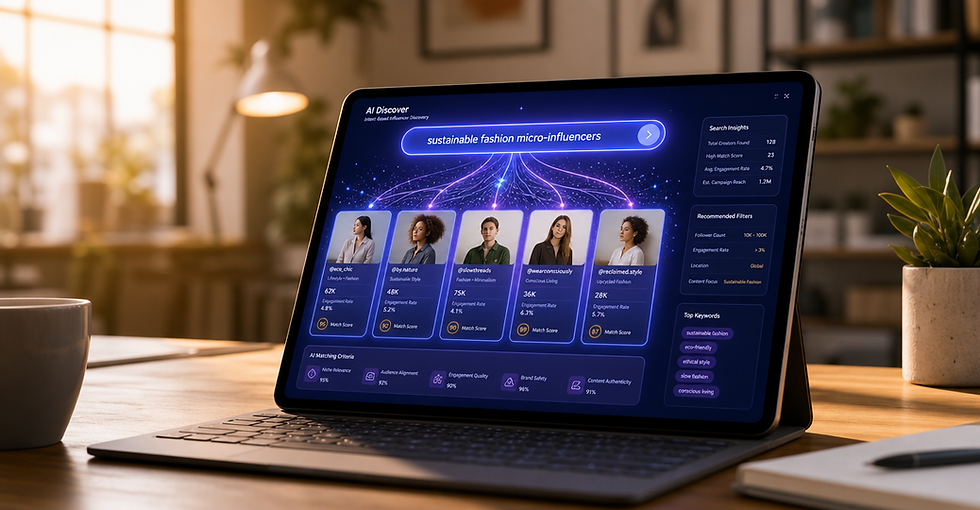
Pica Cast was built to solve this exact problem: transforming natural language requests into structured, campaign-ready shortlists 10x faster than manual research. Instead of forcing marketers into rigid filter boxes, Pica Cast's intent-first setup lets you describe what you need in plain English, then refines those criteria into editable, actionable data.
Quick Answer
An ai influencer search tool uses artificial intelligence to analyze creator profiles, content, and audience data at scale, matching brands with campaign-fit influencers based on semantic intent rather than manual keyword filters. The best platforms combine natural language search, cross-platform coverage, fraud detection with audience quality scoring, and workflow automation. Agencies report 45% faster discovery times per campaign when using AI-powered tools, and 36.67% of brands now use AI specifically for creator discovery — the most adopted AI task in influencer marketing.
Feature | Traditional Manual Search | AI Influencer Search Tool |
Time per campaign | 3-5 days of manual review | 2-4 hours with structured shortlists |
Search method | Keyword hashtags + follower filters | Natural language + semantic intent |
Fraud detection | Manual vetting per profile | Automated audience quality scoring |
Platform coverage | One platform at a time | Cross-platform unified search |
Why AI-Powered Creator Discovery Outperforms Manual Research
The shift from manual creator research to AI-powered influencer discovery is not about replacing human judgment — it's about eliminating the volume tasks that waste time before judgment even begins.
Traditional discovery workflows force marketers to manually filter through databases using rigid demographic criteria (follower count, location, category), then individually review hundreds of profiles to assess fit. This approach breaks down when campaign briefs require nuance: "creators who feel authentic, not overly polished" cannot be captured by a follower-count slider.
AI influencer search tools solve this by understanding intent. Platforms like Pica Cast allow you to describe your ideal creator in natural language, then use semantic search to surface profiles that match the vibe, content style, and audience alignment you actually need. The result is measurably faster: agencies using AI-powered discovery report 45% reduction in discovery time per campaign, and when you're managing 10+ concurrent campaigns, that time savings compounds into days of recovered capacity per month.
The data backs this shift. According to the 2026 Influencer Marketing Hub benchmark, 36.67% of brands now use AI for creator discovery — the highest adoption rate of any AI task in influencer marketing, ahead of content generation (21.11%) and brief development (13.89%). Brands trust AI with the funnel's wide end first, reserving judgment-heavy tasks like relationship building for human oversight.
What Separates Effective AI Influencer Search Tools from Basic Databases
Not all influencer discovery platforms are created equal. The market has fragmented into three categories: legacy filter-based databases, AI-enhanced profile search, and content-first discovery tools.
Legacy filter-based databases require you to manually set demographic parameters and return a list of profiles. These tools work for straightforward demographic targeting but fail when your brief requires subjective fit — aesthetic alignment, tone of voice, or thematic relevance.
AI-enhanced profile search platforms add natural language processing and semantic search on top of traditional databases. Instead of setting filters manually, you describe what you're looking for in plain English. Modash offers AI visual search where you upload a mood board and get creators with matching aesthetics. CreatorIQ's Creator Graph processes 250 million social posts daily, trained on over a decade of performance data.
Content-first discovery tools analyze what creators actually say and show in their videos, not just their profile metadata. This approach is essential for TikTok, Instagram Reels, and YouTube Shorts campaigns, where a creator's spoken words and visual style matter more than their follower count.
Pica Cast sits in the AI-enhanced category with a focus on intent-first setup and seed creator reference searching. You can start with a loose idea, refine it through editable criteria, or paste a public creator profile URL whose style you want to replicate — and the platform finds similar profiles across Instagram, TikTok, YouTube, and X. This cross-platform coverage is non-negotiable for agencies: 19.44% of brands outsource creator discovery to agencies, making it the single most outsourced function in influencer marketing.
How Agencies and Brands Use AI Influencer Search Tools to Scale Campaigns
The practical value of an ai influencer search tool becomes clear when you map it against real campaign workflows.
Agencies managing 10+ brand clients simultaneously need isolated environments per client, separate creator lists, and reporting dashboards that never bleed across accounts. Mid-market tools often require workarounds that break at scale, while enterprise platforms offer native multi-client workspaces.
For brands running always-on creator programs, the bottleneck is not finding one perfect influencer — it's building a pipeline of 20-50 campaign-fit creators per quarter, vetting them for fraud, and tracking performance across platforms. AI-powered discovery tools compress the front end of this workflow from days to hours.
Pica Cast's workflow is built around three core actions: describe your campaign intent in natural language, refine the auto-generated criteria, and export structured shortlists. This eliminates the "filter paralysis" that happens when marketers face 20+ dropdown menus before seeing a single result. Instead, you start with intent — "find micro-influencers in the fitness space who focus on home workouts" — and the platform translates that into structured, editable criteria.
Cross-platform coverage is another operational necessity. A beauty brand running a product launch needs creators on Instagram for feed posts, TikTok for short-form video, and YouTube for long-form reviews — all discovered, vetted, and managed in one place. Pica Cast's unified search across Instagram, TikTok, YouTube and X means you build one campaign brief, not four separate discovery processes.
FAQ
What is an ai influencer search tool?
An ai influencer search tool is a platform that uses artificial intelligence to analyze creator profiles, content, and audience data, matching brands with campaign-fit influencers based on semantic intent, natural language queries, and behavioral patterns rather than manual keyword filters.
How much faster is AI-powered creator discovery compared to manual research?
Agencies using AI-powered discovery tools report 45% faster discovery times per campaign, compressing what used to take 3-5 days of manual review into 2-4 hours of structured shortlist generation.
What platforms should an influencer discovery tool cover?
At minimum, an effective tool should cover Instagram, TikTok, and YouTube. Pica Cast currently supports discovery across Instagram, TikTok, YouTube and X. Platform coverage needs vary by industry, with gaming brands often prioritizing video-first platforms and B2B marketers increasingly exploring creator partnerships beyond traditional social networks.
How do AI tools detect fake followers and fraud?
AI-powered fraud detection analyzes behavioral signals including missing profile photos, abnormal follower-to-following ratios, account age, engagement patterns, and growth curves. Advanced platforms report high fraud-detection accuracy by combining multiple data points, though human review remains important for final vetting decisions.
Can Pica Cast find creators who are already talking about my brand organically?
Pica Cast's seed creator reference search lets you paste a supported public creator profile URL whose content style or audience matches your campaign, then finds similar profiles. This approach helps identify creators with aligned audiences who may already have affinity for your brand category.
Conclusion
The shift from manual creator research to AI-powered influencer discovery is not a trend — it's a structural change in how brands and agencies operate at scale. With 59% of marketers now using AI for creator discovery and 36.67% of brands adopting AI specifically for this task, the question is no longer whether to adopt an ai influencer search tool, but which platform aligns with your campaign volume and workflow needs.
Pica Cast was built for teams that need to move fast without sacrificing fit. Instead of forcing you into rigid filters or overwhelming you with database clutter, it starts with your intent and translates that into structured, editable criteria. The result is 10x faster creator research compared to manual spreadsheet methods, better-fit shortlists, and the confidence that comes from data-driven discovery instead of guesswork.
Ready to find better-fit creators faster? Start your search with Pica Cast today: www.picacast.com
References
Syncly. "Best Influencer Discovery Tools for Agencies: A Data-Driven Comparison for 2026." https://syncly.app/blog/best-influencer-discovery-tools-agencies
Digital Applied. "AI in Influencer & Creator Marketing: 2026 Playbook." https://www.digitalapplied.com/blog/ai-influencer-creator-marketing-2026-playbook
Modash. "8 Best AI-Powered Influencer Discovery Tools." https://www.modash.io/blog/ai-influencer-discovery-tools
Influencer Marketing Hub. "2026 Benchmark Report." https://influencermarketinghub.com/influencer-marketing-benchmark-report/

Comments